
1-2-3 Inner Game
- Dhiren P. Harchandani
- 11 hours ago
- 4 min read

You've Already Used 93% Of It
Listen to the audio version of this issue
Was this newsletter forwarded to you?
I came across an article a few years ago called The Tail End by Tim Urban. I haven't been able to put it down since.
The premise is almost too simple. He maps out, in dots on a page, how much time you have left with the people in your life.
The dots are not abstract; they're countable, and they're small.
Start here.

.
Four thousand six hundred and eighty boxes. That's the whole allocation.
A calendar shows you next Tuesday. This shows you the bottom of the page.
Find your age on the left. Everything above that row is spent. Not budgeted, not deferred. Spent.
The week you're in right now is one box.
Now break the grid into who you actually spend it with.
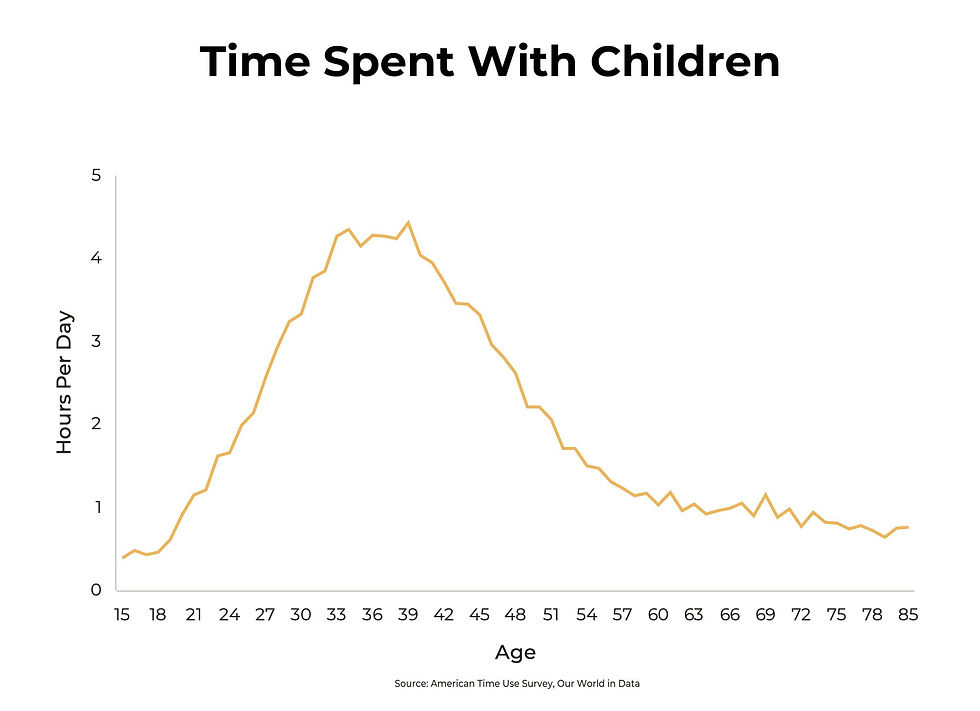
Time with your children is not a gentle decline. It's a spike.
It climbs fast and it sits high for a stretch that feels endless while you're inside it. Then it drops hard the moment they leave, and it never comes back up.
Here's the cruel part. The people standing on top of that spike are the same people working the hardest. Building the business. Chasing the title. Telling themselves, "it's a season."
It is a season, and that's exactly the problem.
If your kids are small right now, you are standing on the peak. It doesn't feel like a peak. It feels like exhaustion. It's still the peak.
Now, the one that hit me hardest.

Time with your parents and your siblings doesn't slope. It falls off a cliff.
Every day of your childhood, breakfast to bedtime. Then you leave home at around eighteen and it's over.
By that point we've used something like 93% of the in-person time we will ever spend with our parents.
Read that again.
Ninety-three percent. Already gone.
Everything after that is the long tail. A few weekends a year. A handful of dinners. A countable number of holidays.
I did my own math that night. I wish I hadn't, and I'm glad I did.
I've spent 25 years around numbers. Pipelines, valuations, forecasts, comp plans. I've always had a bias toward action once I had a number in place.
That was the first number in 25 years I did nothing with.
And here is the one nobody prepares you for.

Time alone is the only line that climbs. It rises steadily your whole life and it doesn't stop.
The hours that used to belong to your parents, your children and your friends do not get reassigned to someone else. Nobody fills that space for you. The relationships you don't actively hold on to are simply gone, and what replaces them is time on your own.
Three lines. Two of them fall. One of them climbs. And every one of them is drawn on the same grid of 4,680 boxes.
There's a companion idea from an investor named Graham Duncan. He called it being a time billionaire. A million seconds is 11 days. A billion seconds is 31 years. Most of us are sitting on a billion or more and have no relationship with that fact at all.
We build entire cultures around dollar billionaires. Nobody celebrates the one asset you cannot earn back.
I sit with leaders every single week who measure everything. Pipeline. Burn. Headcount. Retention. Every number the business needs.
Not one of them tracks the number that is actually running out.
I know why. I've done it myself for a quarter of a century. The business number is solvable. You can work harder at it. You can hire against it. You can fix it next quarter.
This one you cannot fix, you can only spend it better.
Last week I wrote that nobody has it all. Every visible win is the end of a private sacrifice.
Here's what I left out. The sacrifice is not paid in money. It is paid in boxes on that grid. And boxes do not come back.

So last year I committed. I would visit my parents as often as I possibly can.
Not when the calendar clears.
Not when the quarter closes.
As often as I possibly can.
I'm writing this from Manila.
My son and I flew in and surprised them. No warning. We just showed up at the door.
I will not forget my mother's face. That half second before she understood what she was looking at, and then the sound she made when she did.
Nothing about the trip has been remarkable. We've eaten. We've sat around. My son has been listening to stories about me that I would rather he didn't hear, and my parents have been enjoying telling them far too much.
Three generations in one room, doing nothing in particular.
Look at the second graph and the third graph again. In that one room, I was on both of them at the same time.
That's the whole thing.
And I keep thinking about how close I came to not doing it. There was a version of this month where I stayed put, worked, told myself I'd go at a better time.
That version costs nothing today. It costs everything later.
The article doesn't tell you what to do with any of this. It just shows you the dots. And the dots do the work.
So this week, don't audit your calendar. Audit one line. Pick a person. Work out honestly how many times you'll actually see them again.
Then decide whether that number is acceptable to you.
Then go.

Until next week:
Pick one person, do the math, then book the thing.
— Dhiren

Comments